
Josh Hack
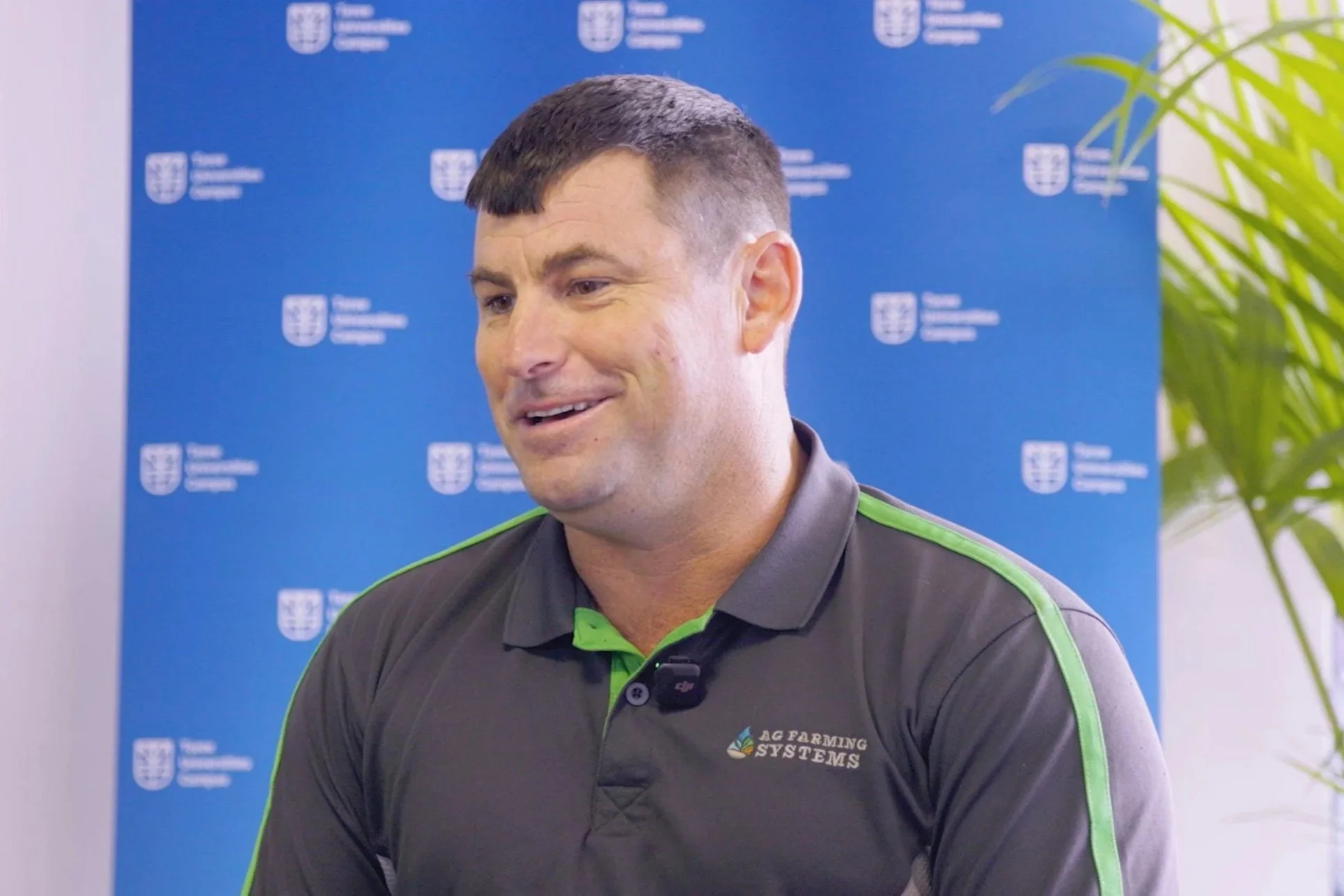
Snapshot:
Industry / Sector: Agriculture & Farming
Career Type: Business Owner
Education Pathway: TAFE & Apprenticeships, University
Mid Coast Connection: Relocated to the Mid Coast in 2011
The Blurb:
Josh Hack, founder of AG Farming Systems, shares his remarkable journey from showing sheep and cattle as a teenager in Bridgewater, Tasmania, to running his own agronomy and drone business on the NSW coast. Leaving school in Year 10, Josh completed a Cert II in Agriculture at TAFE before landing an apprenticeship on a diverse mixed-enterprise farm at Cressy. His hunger for learning took him across NSW — from jackarooing on big properties around Coonamble, to farm management, to studying agronomy at Wagga, to working as an agronomist and managing a cotton farm — before settling on the coast in 2011 and launching his own business in 2021.
He discusses the skills that enabled his wide-ranging career — negotiation, recognising your own limitations, and surrounding yourself with people who complement your weaknesses — and explains why he values helping farmers find answers, especially in tough times. Josh also reflects on the importance of enjoying each step of your journey, asking questions without fear, and celebrating small achievements along the way rather than rushing to the top.
-
Many of our Human Library participants are happy to continue sharing their insights beyond these videos. Whether it’s a chat over email, a phone call, or even a visit to your school or group, they may be open to offering further advice and perspective.
Every person’s availability is different, so we’ll work with you to find the best way to connect.
Click the link below to get in touch — we’d love to help you
-
Current Role – Founder of AG Farming Solutions (est. 2021), splitting his time between drone spreading and spraying operations (60%), cattle on four leased properties (10–20%), and agronomy services for farmers (20–30%).
Career Path – Grew up in Bridgewater, Tasmania; showed sheep and cattle through high school; left in Year 10; completed Cert II in Agriculture at TAFE in Burnie; apprenticeship on a mixed farm at Cressy, TAS; migrated to NSW to study at Tocal Agricultural College; jackarooed on large properties around Coonamble; managed a farm at Gunnedah while learning from a visiting agronomist; studied agronomy at Wagga Wagga for three years; worked as an agronomist at Gunnedah for four years; managed a cotton farm; relocated to the coast in 2011; worked as an agronomist and seed rep; started AG Farming Solutions in 2021.
Key Skills – Negotiation, recognising personal limitations and bringing in complementary expertise, networking, adaptability and retraining across different environments, research and problem-solving, communication with farmers.
Challenges Shared – Retraining from alkaline to acid soils after relocating, navigating multiple career transitions and relocations across states, the constant need to keep learning in a field where the environment and conditions are always changing, and the steep learning curve of starting a small business.
What He Loves – The continuous learning and the fact that there's always more to discover than what's known, networking with industry and key stakeholders, helping farmers — especially during tough times — by providing answers or connecting them with the right people, and seeing the tangible results of his work.
Advice to Younger Self – Don't rush to the top; enjoy the moment and be valuable where you are. Turn up on time, use your initiative, and ask questions without fear of looking foolish. Celebrate the small successes along the way, because focusing only on the negatives makes the journey harder than it needs to be.
-
"This is the good thing about agriculture, is you never know everything. It's so much to learn."
"There's a difference between value and worth and you got to understand what that is."
"It's understanding that there's more we don't know than what we know."
"If I've got someone asking me questions, they're the people that I want around me because they want to learn and they want to develop."
"You've really got to celebrate the successes because often we can focus on the negatives about work... But you got to look at the success."
-
[00:00] Intro
Today we're joined by Josh Hack from AG Farming Systems. Josh will talk to us about his journey, the pathway and the skills he has used to get to where he is today.
[00:26] Can you tell us a little bit about what your work looks like today?
Yeah, so my work at the moment, we've sort of transitioned a bit into drones as well. So we run three spreader drones and spraying drones that can lift up to 50 kilos and that sort of stuff. So that's probably about 60% of my work. And then I've got about 10 to 20% work cattle — we lease four properties — and then the other 20 to 30% is helping farmers as an agronomist.
[00:59] When you say you're doing some drone work, what kinds of things do you do with drones in your line of work?
It's expanding all the time. Like it's new technology and there's something out there that is coming along every six months. So currently in Australia, only six to eight weeks ago, the newest biggest drone came to the market, which lifts up 100 kilos. We've still got the 50 kilo ones, but we can spread seed for pastures for farmers. We even do it on a lot of sporting fields and things like that. And the good thing about them is that there's no traffickability. So we're not running over any ground, compacting any soil, damaging any pastures. We've just gone through some pretty bad floods and we do get wet quite often here. So the drones have been really effective at getting that pasture and fertiliser and all that sort of stuff on at the right time.
Also, we can spray, so we can take the tanks out and put a spray tank in and then we can spray on those fields or the pastures. If we're cropping for corn, for example, we're coming into summer now, so we've got a lot of corn going in. So that's what I've been doing the last two days, putting Round Up out and stuff like that and trying to get corn in the ground. And we have a lot of insect pressure as well. So once the corn gets to a certain height, you can't get gear in there. So we can fly over with the drones and control things like fall armyworm and other insect species and stuff like that.
[02:23] Can you tell us a little bit about your pathway? Where did you go to school or how did you get to where you are?
So I'm from Tassie originally, so down near Hobart, just north of Hobart, a place called Bridgewater. I have always been into agriculture since high school. So I showed sheep and showed cattle and all that sort of stuff. Left in Year 10. So I only did Year 10 in high school, didn't go to Year 11 or 12, and then went and did a TAFE course up in the northern part of Tassie called Burnie. And that's where I did my Cert II in Ag, there for sort of eight months and then got an apprenticeship on a farm.
So I started out in this apprenticeship on a farm down at Cressy in Tasmania, which was an amazing opportunity. Like it's one of those farms that does everything — it's got canola, wheat, barley, 12,000 sheep, it's got 400 head of cattle, they do potatoes, they do. And it's just such a great opportunity. One day you're crutching sheep and the next day you're harvesting potatoes and there's just a lot of stuff going on. So I really learnt a lot from those farmers, but I wanted to study more.
So after finishing my apprenticeship, I headed to NSW to study at Tocal. So that was my migration north to start with and never really gone back to Tassie to live. I'll go back to visit my family — all my family's in Tassie — but I've been in New South Wales since. Went out to Coonamble, done a sort of 12 months out there working on big properties, big gear. Back then I just loved tractors. I wanted to drive big tractors and have fun on big tractors. I was only young. So 450 and 500 horsepower tractors and it was big areas. They give you a motorbike to go around and check cattle and lots of stuff. So that was really good as a jackaroo to start out, and then went back to Gunnedah to manage a farm. And that was my start of my education again, to start to go right, now I was learning off this agronomist that was coming out and teaching me a lot of this stuff that was going on when I was managing. And I thought that's really cool. The stuff that I'm learning is really good.
So then I decided I wanted to go to uni and study agronomy. So I went down to Wagga for three years studying as an agronomist down there. After completing that, went back to Gunnedah, worked as an agronomist there for about four years and then went and managed a cotton farm after that, and then moved to the coast in 2011 from there. So I had to retrain myself. And this is the good thing about agriculture is you never know everything. It's so much to learn. And even like yesterday there was a webinar we get on to learn some stuff that's going on. And the environment's always changing and weather's always changing and there's so much to know, and in different years. So I had to retrain into acid soils, whereas out there it was alkaline soils. I had to retrain myself and I've been on the coast here now since 2011 working as an agronomist, a seed rep, and then started my own business in 2021, which is where we are now. So really early days for a small business for me. Big change, but it's exciting.
[05:40] You've obviously had a lot of change, a lot of movement. What are some of the key skills you feel like that you use to get through all those changes and also now starting your own business as an agronomist? What are some kind of skills that you've utilised?
I think no matter what business you're in or what job you're doing, you've got to be able to negotiate with people. I'm really big on negotiation. I listen to some podcasts and I think we all, as we develop, want to listen to other people and learn from other people, and learning from other people and then understanding that they've got skills that you don't have. And it's recognising what you're not good at and then trying to bring those people on.
Starting it as a small business, that's been big for me because I need to get the accountant right and everything else, because that's stuff that I'm definitely not good at. So it's been able to get those people in your life and go forward. But as you work through different jobs and different people, you need to be able to negotiate one for yourself, your own worth, and what's that worth to them. There's a difference between value and worth and you have to understand what that is. I'm thinking that's really important. And I can't say that I've had a bad employer — of every job I've gone to, and I've been to a lot over the years, I've always had really good employers that have done the best for me — but I think it starts with your negotiation with them as well.
I think being able to negotiate and be employable and be someone that you want to develop at the point you're at. It's great to have dreams, great to have ambition and lots of stuff. But I do find sometimes some of those people, they want to be the CEO and they just left school and it's like, yep, that's great, but let's enjoy where you are. And I think that's what I really try to do, is enjoy the position you're in and what you're doing. Having ambition and all that stuff is great, but you've got to enjoy that moment and try and make the most of those moments. Otherwise you sometimes don't get that next step.
[07:44] Yeah, work through and learn at every step, right? Yeah, amazing. What is it that you love about being an agronomist?
The learning and the changing and the networking. So it's not just what I know, and a lot of the times it's what you don't know. And that's what we find in agriculture. Because I do a lot of research as well, so we have our own research equipment where we do planting of different trials and stuff. And the more you learn about research, you actually learn about another 50 questions from that one research. So it's understanding that there's more we don't know than what we know. And if you can try to keep on working on that, what you don't know and finding that, I find that excellent because that's what people want you to do. They're doing their own business and their own stuff and they want you to find out what they don't know and help them.
And sometimes you can help them straight away with your knowledge and experience, but a lot of times it's about the research and the networking to find out who does know. And if we don't know, where do we find it? And that's the key, is being able to network with a lot of people. And I really enjoy that social networking with the industries and all that sort of stuff and the key stakeholders and to try and get that right information to the people that need it.
[08:56] How do you feel your personal values are reflected in your work? How does your work bring out your personal values, things that are important to you?
Probably my ability to help. When things are tough and a lot of farmers are going through a lot of tough things, I really enjoy being someone that can help them get the answers they need, because sometimes we get to a point where we're stressed and there's a lot of stress out there at the moment, and being able to relieve some of that stress with just some simple information or giving them to the right person. So a lot of the time it's a lot of direction-changing stuff. So to me, I reckon it's my ability to be able to help and give answers to people is what I like.
[09:48] And what would be one piece of advice you would give someone younger starting out or maybe reflecting back on your younger self? What would be a key piece of advice?
Don't be someone that just wants to get to the top — enjoy that moment. Be valuable to the people that are around you as best you can, add value and be employable. And that's about simple things — turn up on time, be useful, use your initiative, ask questions. Someone like me, if I've got someone asking me questions, they're the people that I want around me because they want to learn and they want to develop and they're going to be able to do the job rather than someone that just pretends they know and tries to fiddle through with it.
So definitely ask the questions and enjoy the steps along the way. I think that's the key. And I reckon early on sometimes I didn't do that because I was just busy wanting to work. But I think you've really got to celebrate the successes because often we can focus on the negatives about work, when it's a hard day's work and it's hot, all that sort of stuff.
But you got to look at the success. And what I really loved about when I was younger, I'd sit on tractors for 16 hours a day and I enjoyed it because I got overtime and overtime for me back then was great. But you'd finish a paddock and it was all plowed and it's all done. Or you'd plant a paddock and it's all done. See that crop come through. Celebrating all those achievements through those little points is really, really important going forward.
Please note: All content is correct at the time of recording.
