
Darren King
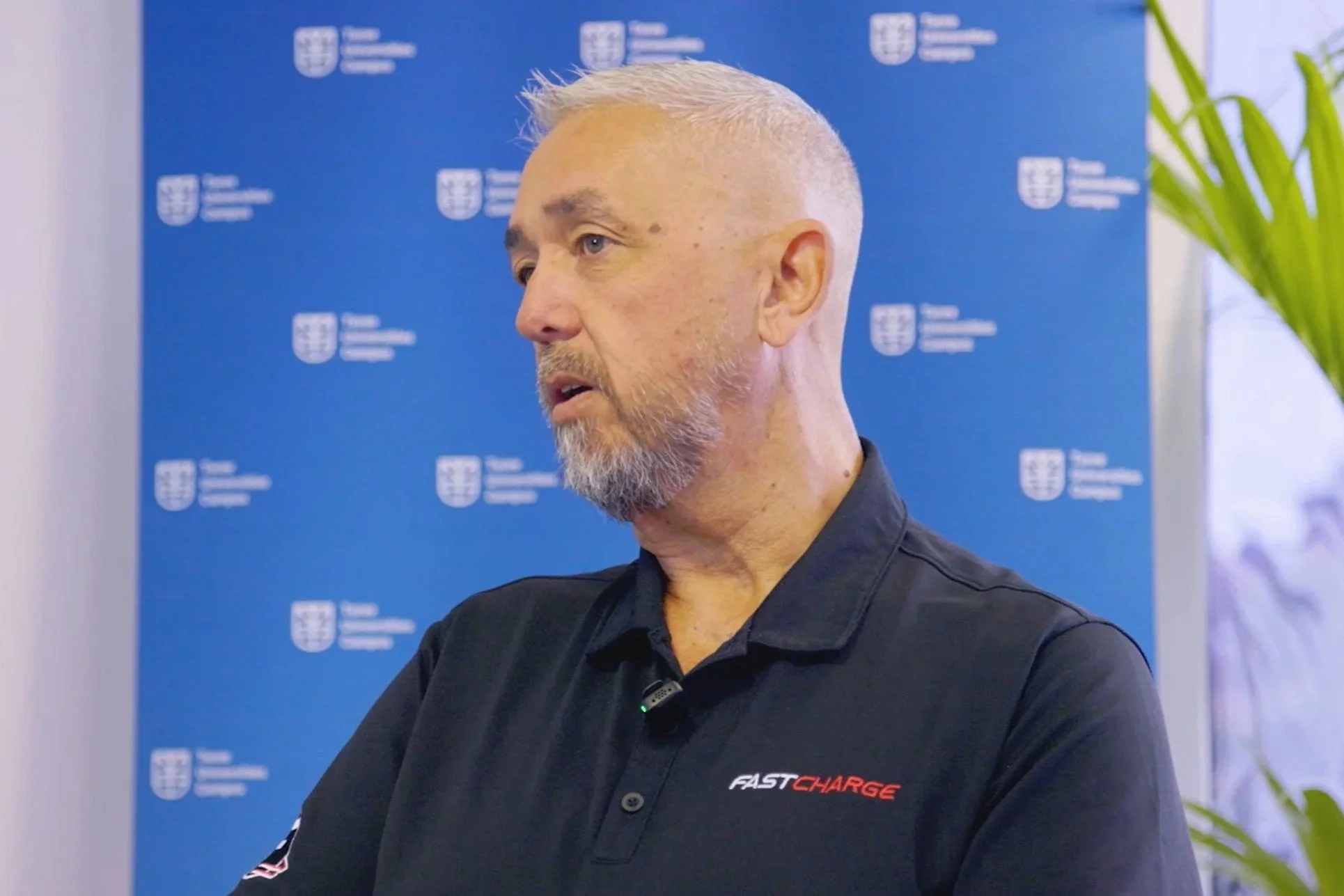
Snapshot:
Industry / Sector: Energy & Technology
Career Type: Business Owner
Education Pathway: Self-Taught
Mid Coast Connection: Established a global business in Taree in 2012
The Blurb:
Darren King, founder of Fast Charge Australia, shares his unconventional journey from a non-traditional education background to running a global business providing electric vehicle power solutions for airports and distribution centres. Leaving school in Year 10, Darren worked a variety of roles including prison officer, security guard, truck driver, and printer before discovering his aptitude for sales. Rising to become a national sales manager for a battery company, he launched Fast Charge Australia in 2012 from his garage, leveraging the expertise of accountants and lawyers to fill his own knowledge gaps.
He discusses the skills that enabled his success — keen observation, active listening, and resilience in the face of rejection — and explains why he values flexibility, family time, and trusting your gut. Darren also reflects on the importance of backing yourself early, ignoring naysayers who advocate for the "well-worn path," and recognising that failure at a young age is simply part of the learning process.
-
Many of our Human Library participants are happy to continue sharing their insights beyond these videos. Whether it’s a chat over email, a phone call, or even a visit to your school or group, they may be open to offering further advice and perspective.
Every person’s availability is different, so we’ll work with you to find the best way to connect.
Click the link below to get in touch — we’d love to help you
-
Current Role – Founder and Director of Fast Charge Australia (est. 2012), providing battery and charging solutions for electric ground support equipment at airports and large distribution centres across Australia, New Zealand, and Southeast Asia.
Career Path – Left school in Year 10; worked as a prison officer at Long Bay Jail, security guard, truck driver, and in printing; transitioned to sales; became National Sales Manager for a battery company; founded Fast Charge Australia in 2012 starting from his garage; expanded to five companies globally with offices in Taree, Singapore, and the US.
Key Skills – Observation, active listening (talking less, listening more), resilience, risk-taking, delegation (leveraging experts like accountants and lawyers), and hiring for attitude and adaptability over formal qualifications.
Challenges Shared – Starting a business without formal business training, managing cash flow in the early days (living on credit cards), facing skepticism from others who doubted his ability to succeed, and overcoming the discouragement of risk-averse family and community members.
What He Loves – The excitement of working in and around airports, the flexibility and freedom the business affords to spend time with family, and the ability to travel the world with his children.
Advice to Younger Self – Back yourself sooner and trust your gut. Don't let risk-averse people convince you to take the well-worn path. If you think you can do it, do it early—even if you fail, you have plenty of time to recover and try again.
-
"I didn't fit in ... I always knew I was going to get to the workforce as early as I could and I was probably going to get more of my life education from different jobs."
"I was smart enough to lean on some good people. We got a really good accountant, we got a really good lawyer, we got a really good bookkeeper. And we leveraged their expertise to fill the gaps that I didn't have."
"Most of your customers will tell you how to win their business if you just shut up long enough and listen to what they've got to say."
"The thing that my job has given me more than anything is the flexibility, the freedom to be able to choose time with family."
"Trust your gut. If you think you can do it and you're prepared to back yourself, you should do it. And the sooner you do it... the more chance you're going to have of success."
-
[00:00] Intro
Today we're joined by Darren King from Fast Charge Australia. Darren's going to share with us a little bit about his journey and the pathways and skills he used to get to where he is today.
[00:28] Could you start us off by explaining a little bit about Fast Charge Australia? Can you tell us a bit about what your work life looks like today?
Well, I guess like anyone that owns a business, life is always busy when you're running a business. Fast Charge Australia provides power solutions predominantly to airports and large distribution centres. We work in Australia, New Zealand and Southeast Asia. So I spend a lot of my time at an airport, on my way to an airport or getting on a plane at an airport. I spend a lot of time travelling and dealing with people in different countries in different time zones. So it makes for a long day sometimes, but it's still fun.
[01:08] Can you explain a little bit about, what that is when you say charging solutions, what does that mean?
So we provide the power that allows electric vehicles to move. In airports, for example, anything that operates under an aircraft's wing is considered to be ground support equipment. So the vehicles that unload the bags from the plane, put the cargo on the plane and move the stairs to the plane, all of those things are converting from internal combustion engines to electric. And that's happening right around the world now. And so we provide the battery solutions for that and then the charging solutions to allow them to operate in some airports 24 hours a day, seven days a week.
[01:46] You started Fast Charge Australia, is that correct? Can you explain what's the pathway that led you to where you are today?
Very different pathway to what a lot of people would imagine. I didn't finish high school, didn't go to university. I didn't fit into that, which back then I'm older than most people back then. It was a real rigid education process and you either fit it in or you didn't. I didn't fit into that. And so I always knew I was going to get to the workforce as early as I could and I was probably going to get more of my life education from different jobs.
At 15, 16, I really didn't know what I wanted to do or where I wanted to go. I just knew I wanted to put myself in a position to one day work for myself. So I took lots of different jobs and had a lot of different experiences. For a while I was a prison officer in Long Bay Jail, which was a real eye-opener, you know, as a 19-year-old. And I did security work and I drove trucks and I worked in printing and I eventually fell into a sales-type role, which fitted me really well. And I started to then think, you know, in my 20s that perhaps this is the direction I wanted to go in.
And so I ended up being a national sales manager for a battery company. And from there I had an opportunity to start my own business in 2012. And so we started Fast Charge Australia and we imported a specialised charging system from the United States into Australia. Started off in the garage of my house, you know, paying expenses with credit cards and however we could to make ends meet. And we did quite well and we got our first big contract and everybody was excited about that. And all I could think about was how we're going to pay for that now and what was the next thing.
And then we started to hire people and the business started to expand. I didn't have that formal business training and education that I probably should have had before I went and did that. But I was smart enough to lean on some good people. We got a really good accountant, we got a really good lawyer, we got a really good bookkeeper. And we leveraged their expertise to fill the gaps that I didn't have. And we grew the business. Now we have five companies running around the world and I run them all and we run a real lean operation. So the people that we hire have to have a diverse skill set as well. Most of the people that we hire are not university graduates. They're people that have a can-do attitude. They're keen to learn and there's no real formal training for what we do. So you have to get people with life experience who are open to learning and adapting and that's what we've done.
[04:29] And your business is based here in Taree, your head office. How many people do you employ here locally in Taree?
In Australia we have 11 employees, and we would have five in Taree. And then we have a business in Singapore that employs people in Singapore and in Malaysia, Thailand, Vietnam. And we have a business in the United States with a couple of employees there as well.
[04:54] So you touched on a few of these through your story, but can you explain what are some of the key skills that you had to utilise to get to where you are today?
I think probably one of the most critical things were the observation skills: being able to learn to talk less, listen more and watch and learn on the go. And what I found was, especially in a sales-type driven business, most of your customers will tell you how to win their business if you just shut up long enough and listen to what they've got to say. Everybody wants to be seen and heard. And if you give those people the opportunity to be seen and heard, they'll tell you what you need to know to be able to go out and win their business and win their trust and be able to do business with them. So that's probably one of the key things.
The other thing is the resilience. To be a business owner, you're going to run into a lot of down times, a lot of hard times, you're going to get a lot of no's. You come across a lot of people that always believe they know more than you do. “You wouldn't be able to do that or you won't be able to achieve that or you don't have the expertise to go and do that”. And if you listen to all of that and take that to heart, you probably would never start. And I think that's why a lot of people never start a business, because people that they trust or people that they believe know more than them would discourage you from taking that risk. So I think if you're resilient enough and you're brave enough to take a step, you'll be surprised at what you can achieve.
[06:28] And what do you love about your job? What do you love about your work today?
Who doesn't love working at airports? It's amazing! I'm a big fan of aeroplanes and you can sometimes catch yourself standing around watching airplanes take off and landing or pushing back from the gate and get distracted by that. But I think the thing that my job has given me more than anything is the flexibility, the freedom to be able to choose time with family, to be able to be where I need to be to support my kids or to be with my wife, to do things that we want to do together. I've been lucky enough that my kids have all travelled all around the world with me because of work. We've got a place in Singapore where my family come over and spend times for holidays. So having flexibility from the business gives is probably one of the most enjoyable things.
[07:20] Darren, if you had to give one piece of advice to your younger self or to younger students watching this today, what would be your key piece of advice?
It probably would have been to back myself sooner. Kids are going to be told by family members and community members that are risk-averse to not try that, to take the well-worn path. Do what everybody else does. Just conform and do what people expect you to do and don't take the risk.
My advice would be trust your gut. If you think you can do it and you're prepared to back yourself, you should do it. And the sooner you do it, look, even if it didn't go well, even if it went wrong, you're 17, 18, 19 or 30. You've got so much time left in your life to make changes and do other things. The earlier you try, the more chances you're going to have of success.
Please note: All content is correct at the time of recording.
