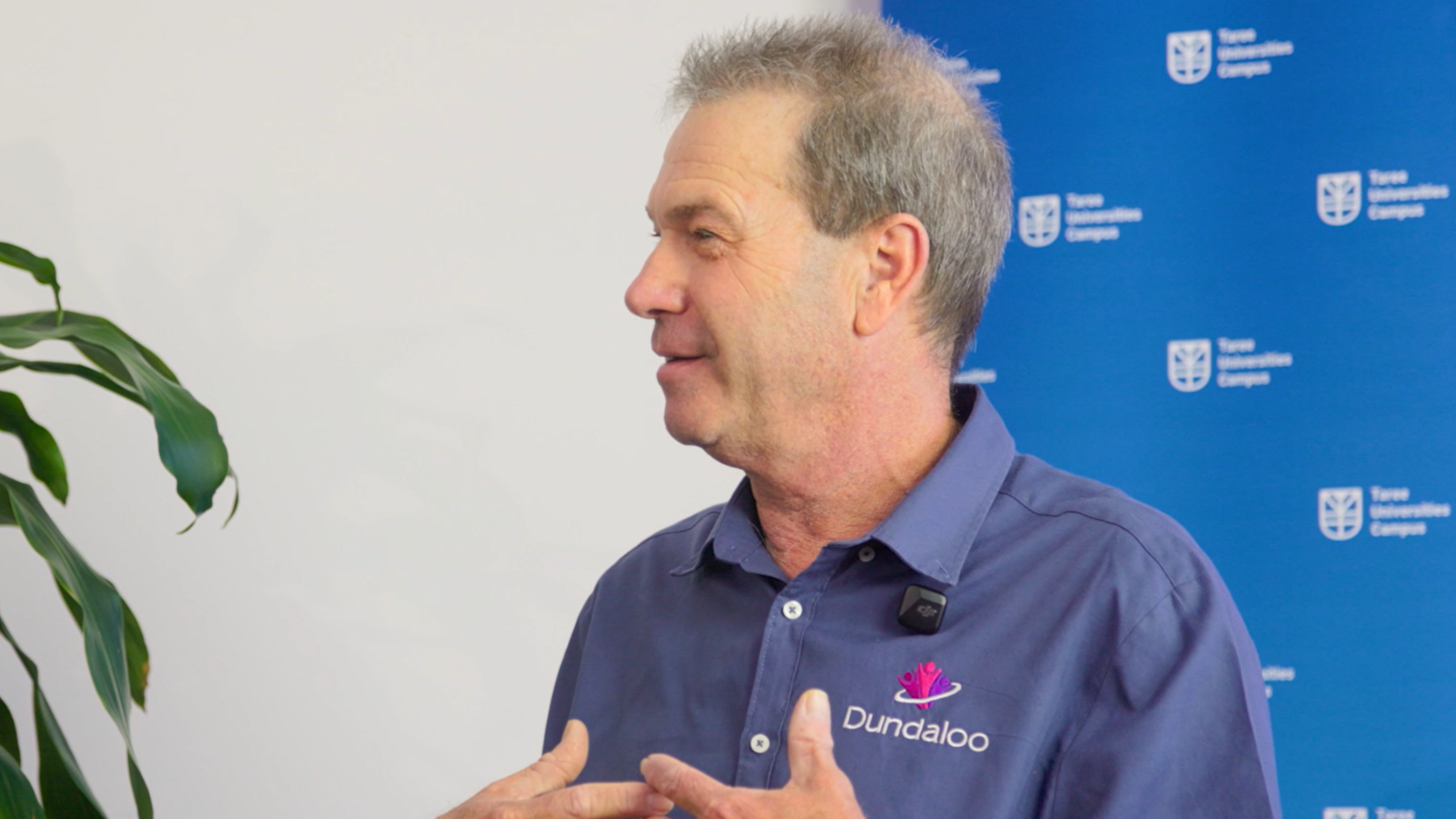
Colin Steber
Snapshot:
Industry / Sector: Community Services, Not-For-Profit, Trades / Technical
Career Type: Employed
Education Pathway: TAFE & Apprenticeships
Mid Coast Connection: Born & raised on the Mid Coast
The Blurb:
Colin Steber is the Enterprises Manager at Dundaloo, a disability support service that has been part of the Taree community for over 73 years. He builds businesses and creates employment opportunities for supported employees across catering, horticulture and hospitality.
Col's career began as an apprentice fitter machinist, but a willingness to never say no took him across Australia — climbing the corporate ladder in manufacturing, building locomotives in Townsville, working the cane fields of Ingham, and spending a decade constructing mine countermeasure vessels for defence right here on the Manning River.
Now five years into his role at Dundaloo, Col brings the same energy that drove him through manufacturing into the service sector. Communication is the skill he champions — the ability to motivate, connect and tackle difficult conversations head-on. His advice: never say no, always step outside your comfort zone.
-
Many of our Human Library participants are happy to continue sharing their insights beyond these videos. Whether it’s a chat over email, a phone call, or even a visit to your school or group, they may be open to offering further advice and perspective.
Every person’s availability is different, so we’ll work with you to find the best way to connect.
Click the link below to get in touch — we’d love to help you
-
Current Role: Enterprises Manager at Dundaloo Disability Support Service in Taree, building businesses — including a commercial kitchen, horticulture gardens and a food truck — that create employment for supported employees.
Career Path: Apprentice fitter machinist → manufacturing and engineering in Newcastle → Townsville building locomotives → cane industry in Ingham → returned to Taree to build mine countermeasure vessels for defence (10 years) → transitioned to Dundaloo as Enterprises Manager.
Key Skills: Communication and motivation — the ability to engage anyone, anywhere, including through difficult conversations.
Challenges Shared: Transitioning from a decades-long manufacturing career into the disability services sector; building enterprises from scratch with minimal initial direction.
What He Loves: Seeing the smiles and capacity building in supported employees, and the can-do culture of a team that genuinely loves coming to work.
Advice to Younger Self: Never say no — always step out of your comfort zone, whether it's taking on a new job or speaking to an audience.
-
"Some people say you want to get something done, give it to a busy person. Well, that's pretty much me."
"I've been in manufacturing all of my life, building trains, locomotives, rolling stock in an engineering field."
"A lot went on on this river that people don't know about."
"Communication. That is by far the biggest skill you can have."
"Never say no. I've always been put in positions and I'll always step out of my comfort zone."
-
[00:00] Intro
Hi, today I'm joined by Colin Steber, an Enterprise Manager at Dundaloo. Col is going to share with us a little bit about his experience and pathways to get to where he is today. Hi Col, thanks for joining us today on TUC's Human Library.
[00:29] Col, could you start by sharing with us a little bit about what your professional life looks like today, what your work day entails, and what kind of things do you do at Dundaloo?
Well, I'm a busy person, and some people say you want to get something done, give it to a busy person. Well, that's pretty much me. I'm on my go all the time. I actually work for Dundaloo, which is a disability support service, been part of the community of Taree for over 73 years. I've been in that for about 5 years now in the role of Dundaloo Enterprises Manager. So we build businesses and create employment opportunities for our participants. We call them supported employees, and we have about 12 supported employees and about 10 staff.
[01:09] Could you give us an example of one of your enterprises?
Catering is probably our biggest one within Taree. We have great customers — the university here is one of our biggest customers as well. We have a commercial kitchen that operates every day, and there's not a day that we don't have catering. In fact, two weeks ago on a Monday, we catered for 160 people. We've done funerals, we've done weddings, but the biggest thing is probably the lunchtime training sessions, business sessions that we actually cater for.
[01:38] Can you share a little bit about your pathway? Where did you land after school or high school, and what's led you to be where you are?
I'm originally an apprentice fitter machinist at Lansdowne Engineering, which used to be Ganinen. When I finished my time, I went to Newcastle — I was working at a Newcastle office — and then I ended up transferring or got an opportunity in Townsville building locomotives, 2800 class locomotives, but no one would know what that actually means. That hauls coal and iron ore. I saw it was a big business — when I left they employed about 43,000 people. So I was always one to never say no, and I climbed the corporate ladder and I've been in manufacturing all of my life, building trains, locomotives, rolling stock in an engineering field.
I moved into management senior level — I was on the floor, then I became a team leader, then I was a supervisor, then I became a production manager, then I was a planner-scheduler when I moved to Townsville building locomotives. And I was actually working also in the cane fields in Ingham, cutting cane. We were actually looking at investigating building cane harvesters. Still today, probably one of the best jobs I've ever had, going around meeting all of the farmers and cutting all of their cane. And I learned so much about the cane industry, and it is so underestimated in this country how much export we actually do. So it was an interesting job.
After that I came back to Taree and I was building boats. And my last 10 years was actually defence, building mine countermeasure vessels for defence. These are vessels that are deployed off ships to go and sweep mines, because these boats are worth a few million dollars, but the ship's worth billions of dollars. They can go through, sweep, find the mine, and if they get blown up, it doesn't really matter. Very high-tech job. A lot went on on this river that people don't know about. We didn't plan any real mines, but we had a few dummy ones on the way that we actually found. So I spent a lot of time going up and down the river with all these different contractors, deploying a lot of technical equipment. That's all I can say. A very interesting job.
But after 10 years, my shoulders were getting tired carrying defence work, and an opportunity came up at Dundaloo. The CEO at the time said, "I need someone to create other forms of businesses so we can create employment opportunities and not totally rely on NDIS. Do you want the job?" And I went, OK, let me think about it. He said, "Tell me when you're ready." I said, "Well, I'm going to finish the contract in about a year's time."
So 18 months later, he said, "Yeah, when you're ready." So that's how it was. I started and he said, "Here's the desk, work it all out." So I didn't really have any direction. But now we took over the original Dundaloo School. I was successful with a grant and we cleared all the land there, and now we've got gardens there, some big horticulture and a nursery that feeds back into our commercial kitchen. We've got a food truck out the front. We've got a collaboration with Chatham High School, which has students there doing work experience on Fridays. So that's a really good partnership — a really inclusive environment, because you've got our supported employees, school students and our baristas, our chefs, all working together.
[05:21] What is it that you love about your job? What do you love about the work you do?
I love seeing the smile on the faces. We've got a really buoyant team because I'm a real pumped-up person and I make sure that everyone in the team is just like that. So people love coming to work.
When we look at reports on sick leave, my team — we don't have any, because everybody loves coming to work. Our supported employees, they love their job, and we have some that work two days, some that work three days a week, and they all work about 6 hours a day, but they love their job. Just to see their face and the fact to see the capacity building that they have had in their job — that makes my day. It's such a difference to what I was used to in manufacturing. Now service industry. And it's like, this is great. Not that I ever didn't like my job, but I love my job now.
[06:17] What did you love about manufacturing, just as a contrast? Obviously it's very different, but you were in that for a lot of years. What did you enjoy about that?
I think I'm a blokey bloke — you build stuff. I was actually designing as an engineer, designing things in the end and building — raw material comes in and out the end comes a locomotive or a high-tech boat, and you might work on it for months or years to get this project and you're part of that. Everyone knows XPT trains, and I'll often say to my wife, "I might have machined that bogie, or I might have done that locking pin on that train." It's still running today. So there's a bit of me in that.
[06:56] And Col, what are some skills that you feel have been really important in your life that you've utilised through your career?
Communication. That is by far the biggest skill you can have, because I know I can motivate my team by standing and talking in front of them and they're just pumped. I think you've got to be able to communicate to anyone and everybody about anything, even though it's difficult conversations — you've got to be prepared to stand up and to have that conversation. I just love motivating people because I'm pretty confident. I know I can go into a room, talk to people and they go, "Yep, we're going to achieve this, we're going to make these goals."
[07:35] And if there's one piece of advice you could give to someone who might be starting out their career or thinking of a career change, what would be your piece of advice?
Never say no. I've always been put in positions and I'll always step out of my comfort zone. Whether it's doing a job or speaking to an audience, I'll say yes. I'll do it.
Please note: All content is correct at the time of recording.
